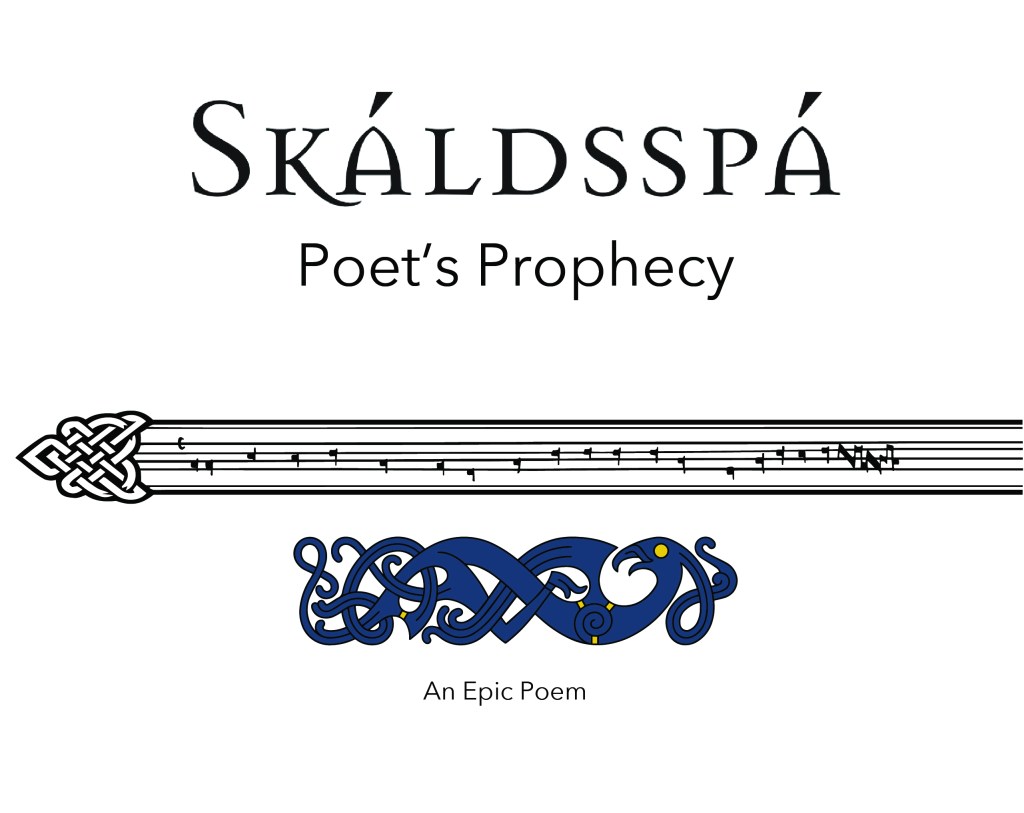
Skáldsspá is a fantasy-genre epic poem written in the style and theme of ancient Old Norse poetry. It tells the tale of Edda (named for the Poetic Edda), a young bard and budding seer caught amidst a conflict between the elven people of the northlands and their ancient enemy, the ice giants. When an early freeze devastates their fall crops, the town calls upon Sigríð, a powerful seer and Edda’s mother, to ask how they can survive the winter. The prophecy Sigríð speaks alludes to a coming clash with the giants and she calls the elves to war, but young Edda disagrees with her interpretation and the story unfolds from their conflicting visions for the future of their people. Edda tries to convince the village there is another path forward, but they are too embroiled in their history with the giants and the prickly dynamics between her mother and uncles, one the crowned king and the other a respected warrior, to heed the words of a child. So, with the help of a raven and an otherworldly-wolf, Edda undertakes a journey to the hall of the giant king to stop the war and to find herself, as she struggles to please but stand up to her mother, grapples with grief over the loss of her sister, and grows into her new powers. Edda is not a chosen one, so much as one who chooses to act. By seeking the wisdom of the spirits, she fights to change the fate foreseen, and though the prophecy does not come to pass in the way she hopes, she makes a meaningful change for both peoples by the poem’s bittersweet end. The story explores the nuance of words, difficult family relationships, gender and power, and the meaning of fate itself, with threads of magic, adventure, and a touch of the cosmos to tie it all together. A song composed “by the heroine” for vocals and harp accompanies the story in Part 4. The story draws inspiration from Norse lore as well as historical writings and scholarly accounts of ancient Viking culture. The word skáldsspá is a compound word translating to “poet’s prophecy” in Old Norse.
Skáldsspá is written in a style of historical Old Norse poetry called Ljóðaháttr, or “song meter.” Rather than a focus on rhyme, this form uses alliteration as an aesthetic mechanism. It’s a beautiful form whose structural elements are very subtle in modern English, almost as if it has no set cadence. Unlike actual historical Medieval poetry, this allows the words to flow almost as if written in prose. At the same time, it is more constrained than prose and that brevity maintains its poetic air. All of these elements lend themselves well to being read aloud, for readers interested in such an experience. For those interested in my translative choices regarding the historical art form, I encourage reading the book’s introduction.
It took me nearly two years to write this book and it’s one of the most beautiful things I’ve ever made. The story actually began as the backstory for a D&D character and blossomed from there. (Those who play might be interested in seeing Edda’s dice.) I’ve printed a few copies for myself and family, but it’s not yet officially published.

In Part 4 of the poem, Edda performs a song called Systur Dreymir (“The Sister Dreams”). It’s a sad song based on the oldest known piece of Nordic music as recorded in Old Norse in the Codex Runicus. I have composed a full version of this song for the harp, which you can listen to below. I’m not a singer, so please be kind 🙂 Also, I recorded this using my laptop over a synthesized instrument because singing and playing my harp at the same time is hard! Eventually I’ll have a professional record it.
© Data Arcana 2018. All rights reserved.
 Jamie L. Molaro