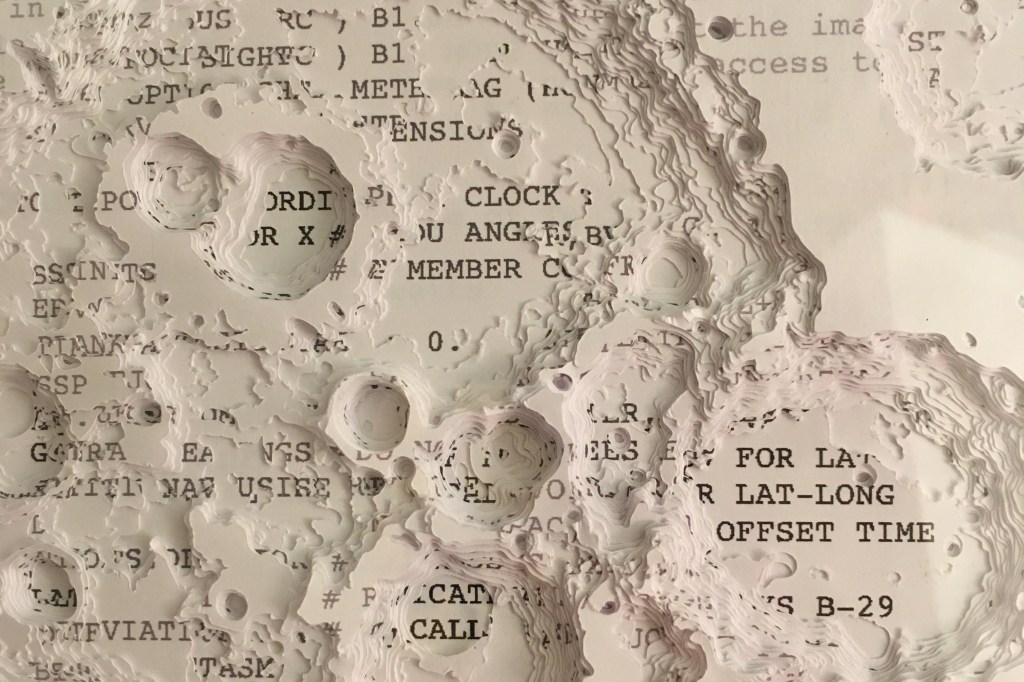
This piece was made using data from the Lunar Orbiter Laser Altimeter (LOLA) aboard the Lunar Reconnaissance Orbiter (LRO) spacecraft. The topography is the same as used in The Book of Moon, though with fewer layers. The text on the pages is original source code for the Apollo 11 guidance computer for the command and lunar modules. The code was written by NASA computer scientist Margaret Hamilton in 1969. It was during this project that she invented the term “software engineering” to describe the process of developing code.
This piece is really a narrative about knowledge building, juxtaposing the knowledge we had to create in order to reach the Moon with data collected of the Moon’s surface by the space program that effort enabled. This chronology seen in the creation and layering of the work also reflects the real way we study planetary surfaces– by observing its history as recorded in their landforms. And, it highlights the importance of contributions to science and engineering from women and people of other marginalized identities and poses the question of what knowledge has yet to be discovered by their exclusion from the field today. This work tends to be people’s favorite of mine, and I think the element of human agency in exploration also appeals to them.
This piece won first place in the Data Art category of the 2020 Art of Planetary Science exhibition and was also featured in the MSU SciComm 2020 sciart exhibition.


I’ve been playing with different color schemes on this piece for a while. The newest iteration is black and white. I really like how it came out, and it’s fitting for the muted colors of the lunar landscape itself. I think it’s here to stay, but more colorful versions are pictured below.
 Jamie L. Molaro